When thinking about what table top material to use in any food service business from restaurants to churches to casinos, granite should be considered.
While you might think there is not a lot to know about granite as it’s just a rock that does not move, there is quite a bit to be learned. Granite table tops aren’t just heavy slabs of rock. They’re a design choice that affects how customers see your space, how much maintenance you’ll do, and whether your investment pays off over time. Here’s what you need to know before making this decision.
Read the 6 tips below about granite to find out why restaurant granite table tops might be just the right option for you.
1. Cost and Target Customer
Before you look at any granite samples, think about who walks through your door. This matters more than the price tag.
The first question that usually arises about granite is the price of each table top. Of course a customer needs to know the price, but considering the return on investment (ROI) probably should be investigated first.
How do you determine the return on investment?
Ask the question,
What materials will help make the most sales by attracting repeat customers?
Obviously, laminate will cost less than granite, and if your customer is a fast food demographic who may not appreciate granite over laminate, then laminate table tops may be your best, most cost effective choice.
A fast-casual spot where people grab lunch in fifteen minutes probably doesn’t need granite tables. Your customers won’t notice the difference between laminate and stone when they’re eating quickly and moving on. In that case, laminate makes sense. It costs less and does the job.
But if you’re running an upscale bistro or a steakhouse where people come for special occasions, granite changes the atmosphere. It signals quality. People notice it, and they remember it. That memory brings them back.
2. Mixing Materials
A very effective use of granite tables is to mix the table materials.
What does mixing materials mean?
Here’s how this works. Put granite tables near windows or in prominent spots where people see them first. Use laminate or wood for the rest. When you pick materials in similar colors, the granite makes the other tables look better than they would on their own. The whole room feels more polished.
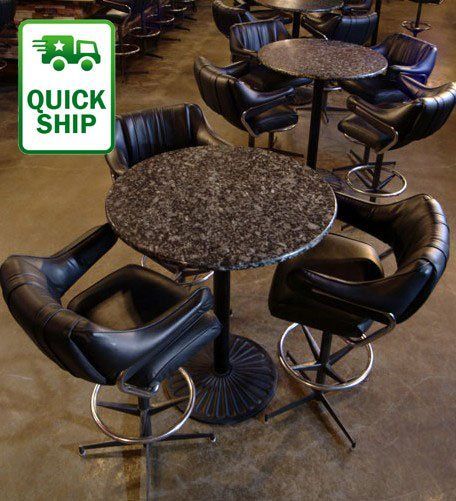
You can also go the opposite direction and create contrast. Black granite with warm solid wood table tops makes both materials stand out.
This is an effective way to keep the cost overall for the restaurant tables, while still using the desired granite tables look for the target customer.
3. The color of granite
Granite comes in more colors than most people expect. It may be surprising to those unfamiliar with granite that the colors range from white to black to gray, beige, brown, and even stones with hints of blue, green, or red.
Many pieces have veining where different minerals create patterns through the stone. Others have a speckled appearance that looks almost like concrete but with more depth.
Granite is found around the world as it was formed from magma and cooled with various chemical compositions giving different colors and hardnesses. If you want to see your options, visit a granite supplier’s warehouse. Walking through rows of massive slabs gives you a much better sense of what’s available than looking at small samples.
4. Using Granite Outdoors
Granite table tops can most certainly be used outside, but there are a few things you need to know before placing them outside. Selecting the right granite color to use outdoors is very important, as dark colors can get hot enough in the sun to burn skin.
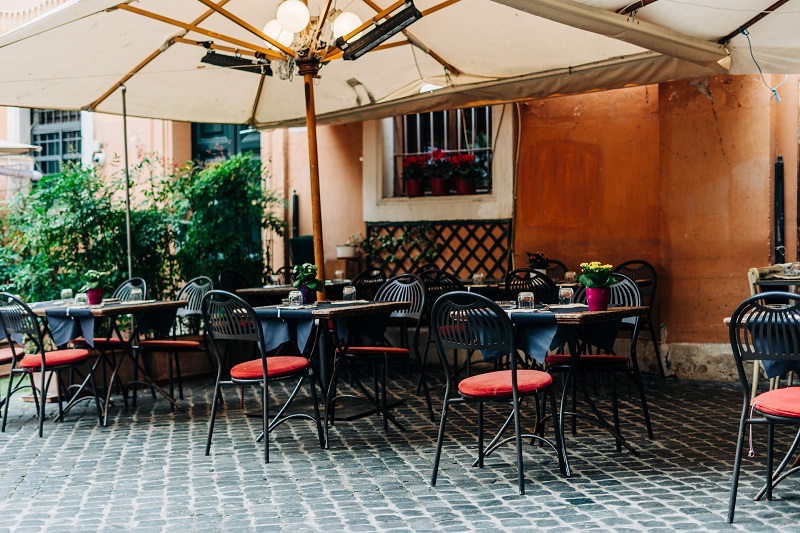
Lighter colors are not affected quite as much by the sun. The other problem is glare. Granite gets polished to a mirror finish, and that shine can reflect sunlight directly into people’s eyes. This bothers not just the person at the table but also nearby diners. Umbrellas solve both problems. They provide shade that keeps the granite cool and blocks the glare.
Both of these concerns, hot granite table tops and glare can be solved by using umbrellas, or possibly a mesh material that covers a patio.
Also, be aware that some granite table tops are made of veneer granite with a core of wood. Before this type of granite table top is used outdoors, make sure the wood is sealed with some type of moisture barrier like paint or epoxy glue.
5. Assembly and Maintenance
When you buy granite table tops, make sure you’re also getting the right bases. Granite is heavy. A standard restaurant table base might not support the weight properly, and if the base doesn’t match the top’s mounting system, you’ll have problems during setup.
Read more buying tips for Granite table top on our guide to granite table top.
It is a good idea to purchase the granite table top and restaurant table base from the same vendor, who can assist you with ensuring the bases will support the table tops.
We at Missouri Table & Chair offers granite tables matching with table bases on a wholesale price.
Granite tables need a minimal maintenance, but you should still check your tables regularly. Look for cracks along any veins in the stone. These are natural weak points where damage might start, such as a crack along vein lines, or screws or glue not holding the base and top together correctly.
Chips in the granite can happen when something hard bangs into the granite table top, like another granite table when they are moved around.
Although these problems are not very common, and like any table top routine inspection and prompt repairs are needed to keep the table tops in good condition.
6. WOW experience
Most restaurants pick safe options for furniture. They go with what everyone else uses. If you choose granite thoughtfully, you create something people notice and talk about.
Match the granite to your overall design. If your walls are warm-toned, pick granite with brown or beige hues. If you’re going for a modern look with cool colors, gray or black granite fits better. The goal is making everything feel intentional, not random.
Separating your food service operation from the competition or just making your staff in a non-retail setting can be done with granite table tops. Investigate colors, blend in with your décor and wow your target audience. When others go for the routine materials for table tops, you can be different and get people talking about your facility.
This doesn’t mean granite works for every business. A college campus dining hall probably doesn’t need it. A children’s play café definitely doesn’t. But if you’re trying to create an atmosphere that feels substantial and well-crafted, granite helps you do that.
Conclusion
Granite table tops cost more upfront than other options. That’s true. But the question isn’t just about initial price. It’s about whether they help you attract the customers you want and whether they last long enough to justify the expense.
If your business depends on creating a certain impression, granite might be worth it. If your customers care more about speed and convenience than ambiance, it probably isn’t.
Think about your space, your budget, and who you’re serving. That tells you whether granite makes sense for your tables.

 While most are within this range, some are shorter. Pub tables are taller and designed for eating while standing vibe.